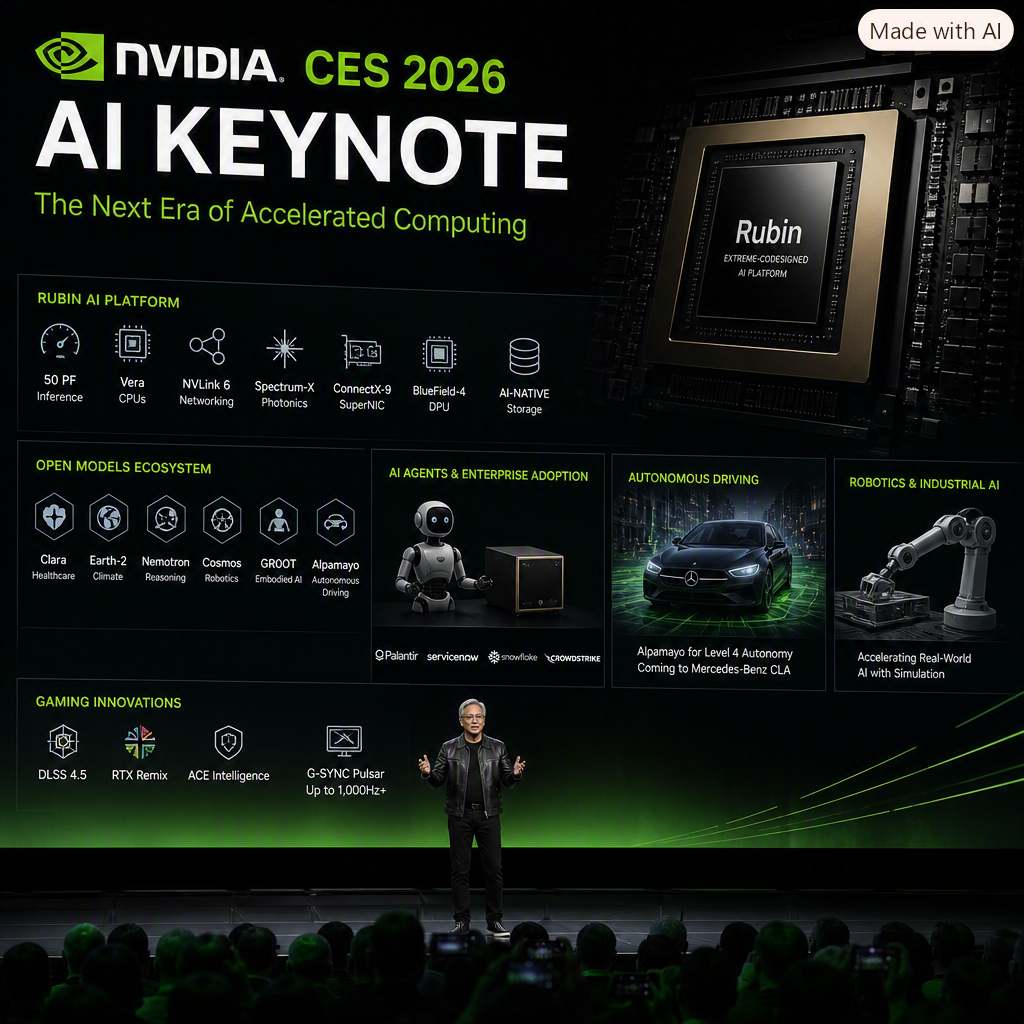
NVIDIA used its CES 2026 keynote to lay out a sweeping vision for the next era of accelerated computing, unveiling a new AI platform, expanding its open‑model ecosystem, and demonstrating advances in autonomous driving and robotics. CEO Jensen Huang framed the moment as an inflection point, saying AI is now scaling “into every domain and every device,” reshaping how industries operate.
Rubin: NVIDIA’s New Extreme‑Codesigned AI Platform
At the center of the presentation was Rubin, NVIDIA’s newest AI platform and successor to the Blackwell architecture. Rubin represents the company’s first fully “extreme‑codesigned” system, integrating GPUs, CPUs, networking, storage, and software into a unified stack optimized for large‑scale AI workloads.
Rubin’s GPUs deliver 50 petaflops of inference performance, supported by new Vera CPUs for data movement, NVLink 6 networking, Spectrum‑X Ethernet photonics, ConnectX‑9 SuperNICs, and BlueField‑4 DPUs. The platform also introduces an AI‑native storage system designed to accelerate long‑context inference, offering significant gains in speed and efficiency.
Huang emphasized that Rubin reduces the cost of generating AI tokens to roughly one‑tenth of the previous generation, enabling faster training cycles and more rapid deployment of frontier models.
NVIDIA Expands Its Open Model Ecosystem
NVIDIA also spotlighted its growing portfolio of open AI models, trained on the company’s supercomputers and released for broad use across industries. The models span six domains:
- Clara for healthcare
- Earth‑2 for climate and weather
- Nemotron for reasoning and multimodal AI
- Cosmos for robotics and simulation
- GR00T for embodied intelligence
- Alpamayo for autonomous driving
Huang underscored that openness is central to NVIDIA’s strategy, arguing that accessible models accelerate innovation and allow companies and countries to participate more fully in the AI revolution.
Personal AI Agents and Enterprise Adoption
The keynote also highlighted how AI is becoming more personal and more local. NVIDIA demonstrated a personalized AI agent running on the DGX Spark desktop supercomputer and embodied through a Reachy Mini robot. The demo illustrated how model routing and local execution can turn AI agents into physical collaborators capable of assisting with everyday tasks.
Major enterprise partners (including Palantir, ServiceNow, Snowflake, and CrowdStrike) are integrating NVIDIA’s agentic systems into their platforms, signaling rapid adoption across the software ecosystem.
Autonomous Driving Takes a Leap Forward
Autonomous driving was another major focus. NVIDIA introduced Alpamayo, an open portfolio of reasoning vision‑language‑action models and simulation tools designed to support Level 4‑capable autonomy. The Alpamayo R1 model can interpret sensor data, reason about actions, and control vehicle behavior, demonstrated through a video of a car navigating complex urban traffic.
The first passenger car built on NVIDIA’s DRIVE platform with Alpamayo will debut in the new Mercedes‑Benz CLA, bringing AI‑defined driving to U.S. roads this year.
Robotics and Industrial AI
NVIDIA also showcased advances in physical AI, including robotics partners and industrial collaborations with Siemens. The company emphasized how simulated training environments are accelerating real‑world deployment, allowing robots and industrial systems to learn faster and operate more safely.